The bacteria is known in our neighbouring countries
Recently, the veterinary surgeons at the Keldur Institute for Experimental Pathology announced that the cause of the infectious coughing disease in horses in Iceland had been confirmed…
Therefore, Eiðfaxi sent a few questions to the equine veterinary surgeon at MAST (the Icelandic Food and Veterinary Authority), Sigríður Björnsdóttir:
Is this bacterium that caused the disease known abroad?
Yes, this particular strain of bacteria is known in our neighbouring countries and it is spread quite widely. Research has demonstrated that it is new here in Iceland. It was not so long ago that people started to analyze the strains of different bacteria so precisely, which is the reason there is no data available about the exact world-wide spreading.
How has the bacterium behaved; have foreign horse owners experienced similar epidemics as we have?
It is difficult to assess this, because this bacterium often is found together with other infectious agents. It has usually been considered to be an infectious agent that makes use of arising opportunities, showing up in combination with other infections. However, lately people have started to suspect that it can also be the original cause of disease in the respiratory system. In locations where horses do have some resistance against it, it does not succeed in causing an epidemic. But when it arrived in Iceland and infected our stock, where all horses were responsive and the environmental conditions favourable for the bacterium, it got a unique opportunity to demonstrate what it can do.
How do you think the bacterium came to Iceland?
I believe it is most likely that it has been brought here with used tack or riding clothes, for example gloves, but it will be very difficult to prove this. It is completely forbidden to import used tack and riding gloves into Iceland, but I suspect these rules have not always been respected. I have received information about people bringing bits to Iceland. This is a very risky thing to do, and I hope that people will realize now that it is not worth taking such a risk. I also want to reiterate that all clothes that have been used around horses abroad need to be washed in a washing machine or sent for dry-cleaning, while shoes and boots must be washed and disinfected. All horsemen should know this and follow these rules.
What kind of influence will this bacterium have on our horse keeping here in Iceland in the near future?
This cannot be predicted with any certainty, but probably it will first and foremost be a problem for young horses in the future.
Is it possible to produce a vaccine against this bacterium?
That is a possibility that will be carefully considered.
How do you think horsemen have managed to follow your advice about control and hygiene?
In most cases, they have done quite well. But if people stable infected horses, the environment will very soon be infected again. So I advise people to maintain the same standard of alertness as we had regarding the export of horses, by stabling only horses that have been free of symptoms for at least one month. They same is valid for the horses that have been in contact with diseased horses. This rule seems to work very well.
Will authorities take measure and change or increase the safety rules to prevent other diseases from being brought to Iceland?
The focus is mostly on education and advertising the rules that we have today, in order to encourage horsemen to behave responsibly. There is already a big advertisement at the airport, and posters with all the rules have been printed and will be distributed in the stables. People can get these posters free of charge at MAST as long as supplies last. We also have brochures with information for foreign guests and clients that can be ordered. There are adverts on many websites, for example of many societies and federations in horsemanship. It is possible to download digital adverts at the website of MAST, www.mast.is , and I encourage all horsemen who have a website, to add these announcements. All this material is available both in Icelandic and in English, and the brochures are also available in German. Horsemen must work together and introduce these rules everywhere, and of course people have to follow them as well!

 Til minningar um Rúnar Geir Ólafsson
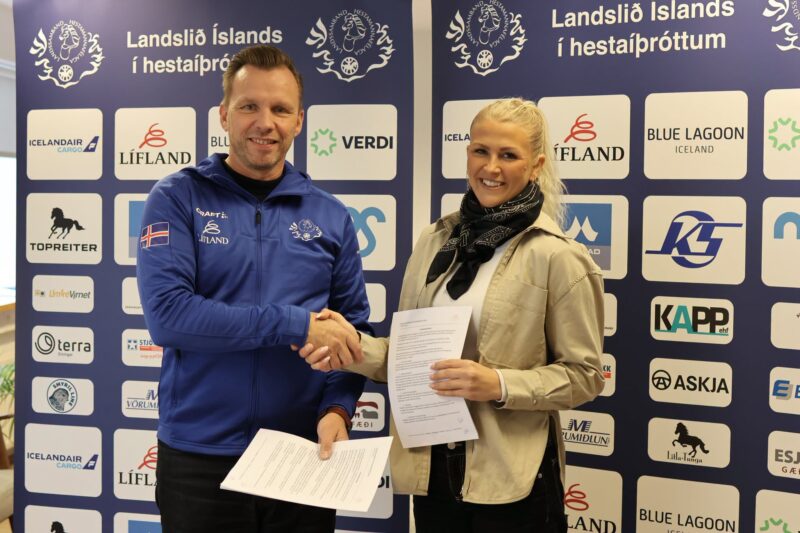
 Vigdís Matthíasdóttir ráðin yfirþjálfari Hæfileikamótunar LH